

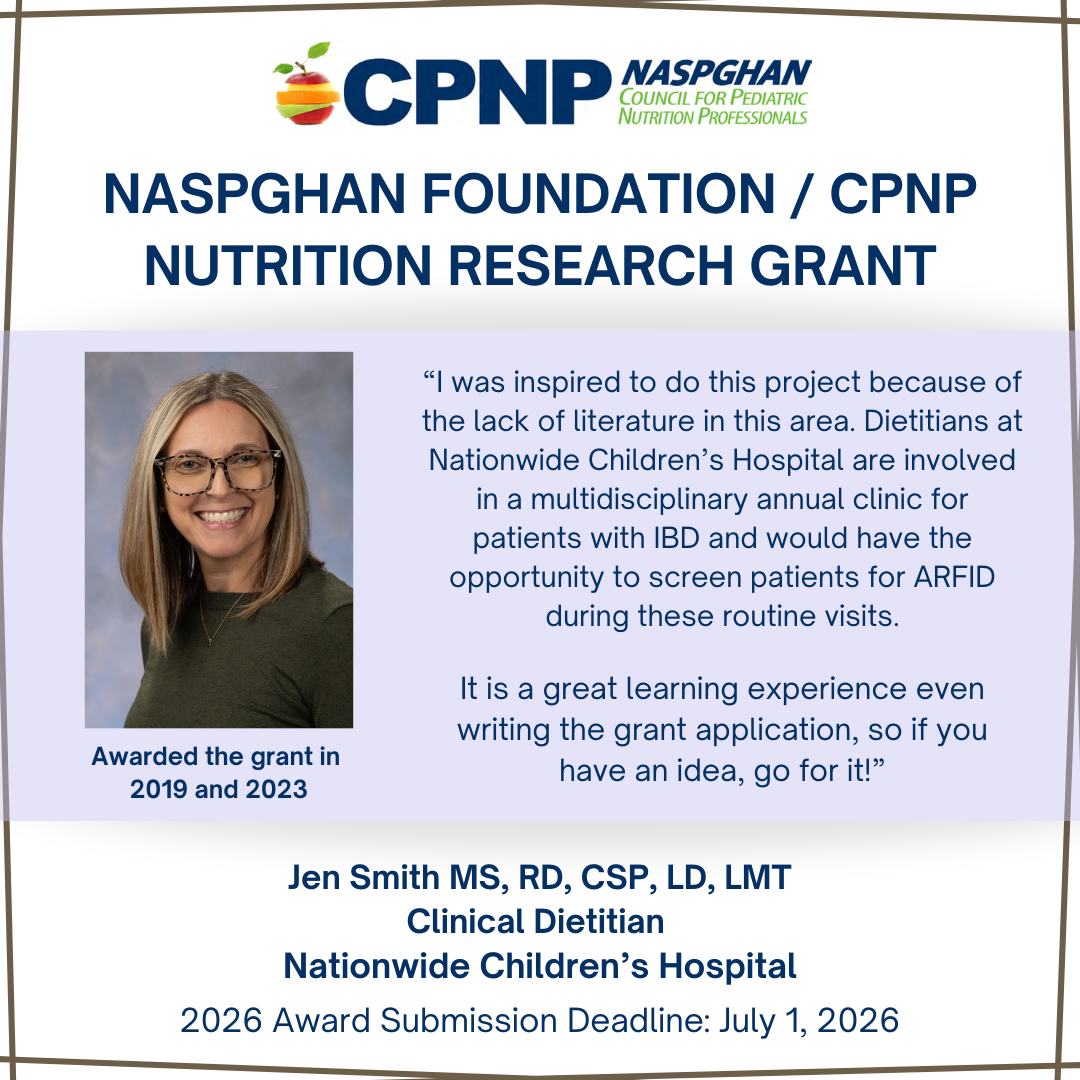
Submission Deadline for the 2026 NASPGHAN Foundation CPNP Nutrition Grant is July 1, 2026. Find out more on NASPGHAN | NASPGHAN Foundation Grants. Below, learn from one of our prior winners on how they utilized the grant! If you are inspired to complete nutrition research, apply for our grant today!
About Jen:
Jen Smith is a registered dietitian, board certified specialist in pediatric nutrition, at Nationwide Children’s Hospital in Columbus, Ohio. Jen has been working in pediatric Gastroenterology, Hepatology, and Nutrition for more than 20 years with a special interest in pediatric inflammatory bowel disease. Jen has been an active member of CPNP, holding positions on the executive committee as research chair from 2020-2023 and has been a member of the NASPGHAN IBD committee and research committee. Jen is a co-host for Nutrition Pearls: the pediatric GI nutrition podcast. Jen has been a member of the Crohn’s and Colitis Foundation for 20 years and was on the National Scientific Advisory Committee (NSAC) – Professional Education Committee member 2021-2024. She has been an active member of the ImproveCareNow Dietitian Working Group for almost 20 years and has been on the medical advisory board for the GI Nutrition Foundation since 2020. She has presented to many audiences locally and nationally, participated in many webinars, contributed to textbooks, blog posts and scientific publications typically on the topic of nutrition and pediatric inflammatory bowel disease. She has been a preceptor for dietetic interns throughout her career and has been a guest lecturer at The Ohio State University for 10 years. She has won 2 awards from the Ohio Academy of Nutrition and Dietetics as well as RD of the Year at Nationwide Children’s Hospital.
Brief description of your project:
Avoidant/Restrictive Food Intake Disorder (ARFID), a disorder with food intake limitations without body image distortions, is present in 10-50% of adults with inflammatory bowel disease (IBD). This study aimed to determine the prevalence of ARFID-related behaviors in youth with IBD and to identify associations between ARFID and various disease characteristics.
What inspired you to come up with your research project?
I was inspired to do this project because of the lack of literature in this area. Dietitians at Nationwide Children’s Hospital are involved in a multidisciplinary annual clinic for patients with IBD and would have the opportunity to screen patients for ARFID during these routine visits.
What are some interesting findings you have from your work?
In this study, the Nine Item ARFID Screen (NIAS) was utilized along with a different screen for other eating disorders. Participants were asked if they experienced food intolerance. Approximately half of our patients described having food intolerance whether they screened positive for ARFID or not.
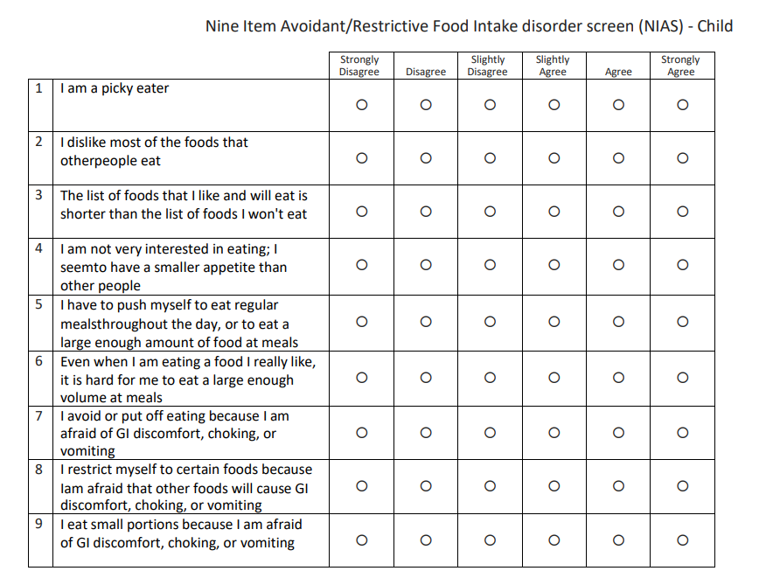
Source: Zickgraf HF, Ellis JM. Initial validation of the Nine Item Avoidant/Restrictive Food Intake disorder screen (NIAS): A measure of three restrictive eating patterns. Appetite. 2018 Apr 1;123:32-42. doi: 10.1016/j.appet.2017.11.111. Epub 2017 Dec 5. PMID: 29208483.
Have you changed your practice since completing your research?
We have not incorporated ARFID screening into our multidisciplinary annual IBD visits at this time; however, it could be a consideration in the future.
How did receiving the NASPGHAN Nutrition Research grant enable you to accomplish your project?
I was able to screen for eligible participants ahead of time and enter data with protected time from the grant. I was able to compensate participants, which likely impacted participation, enabling recruitment of 200 participants in 6 months.
Do you have any advice for dietitians interested in applying to the NASPGHAN Nutrition Grant?
Let your institution know if you are applying for a grant. Your research department knowing before you get the award may help the process be more efficient. Be as detailed as possible in your grant application given the page limits in the application. Enlist several colleagues to review your application and at least 1 person outside of your work area as they may identify content that is not easily understood by someone not working closely with the population which, if clarified, may strengthen the application. Choose a project which can be completed in 1 year and give yourself time for the IRB application process if you are doing a research project (vs quality improvement). It is a great learning experience even writing the grant application, so if you have an idea, go for it!