

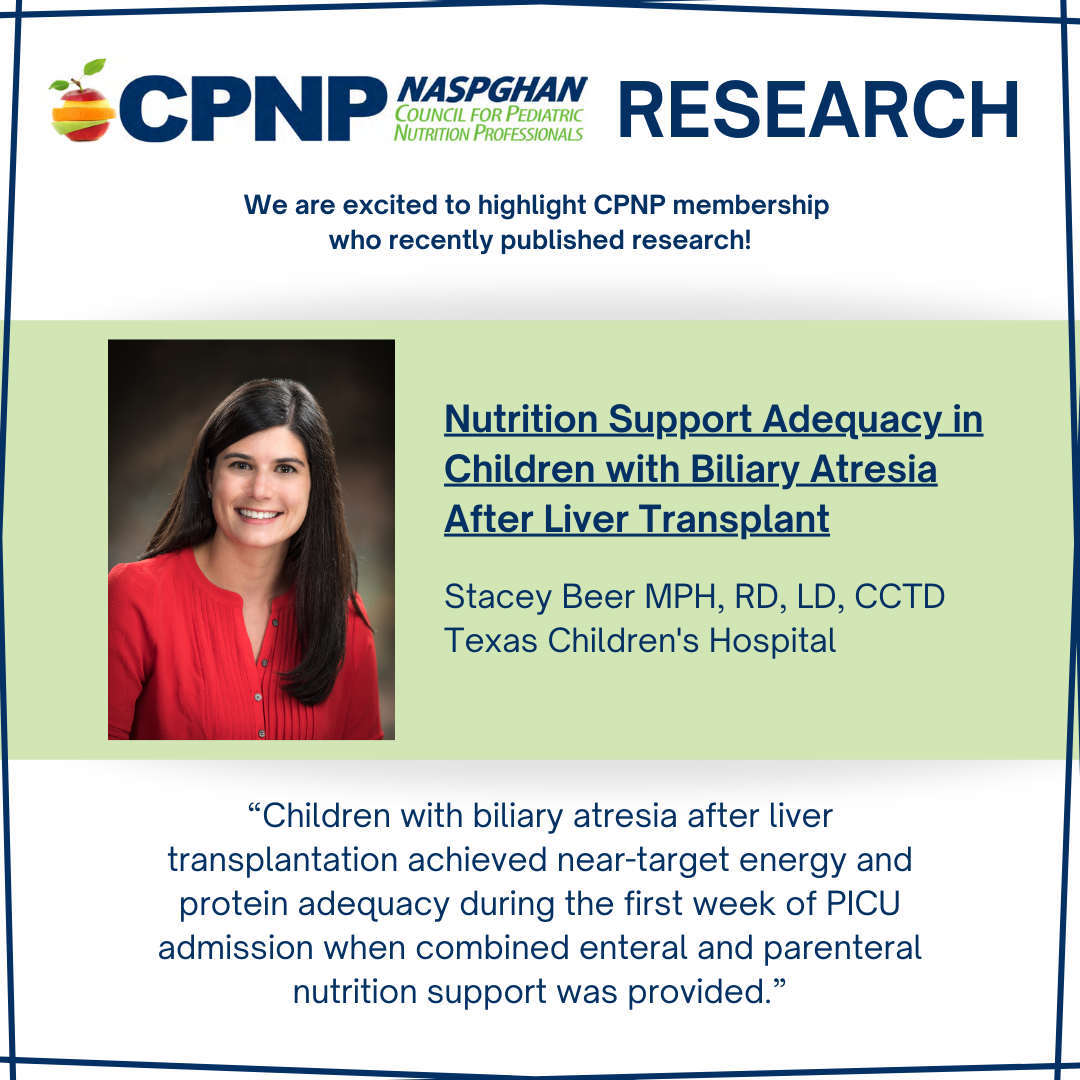
In CPNP, we have an amazing membership that is dedicated to the care of our patients and the future of our field! We look forward to continuing our outstanding research highlights. See below to learn from Stacey on her experience with her research!
Stacey Beer is a pediatric dietitian specializing in Gastroenterology, Hepatology, and Nutrition at Texas Children’s Hospital the largest pediatric liver transplant program for the past 17 years. Stacey has presented posters at presented at national conferences related to pediatric transplant. Stacey serves as a member of the NATCO Nutrition Board and was instrumental in the creation of the Certified Clinical Transplant Dietitian certification. In 2022, Stacey was awarded the inaugural NASPGHAN CPNP Dietitian of Excellence Award and in 2023 she was awarded the Jeanette Hasse Transplant Dietitian of the Year award. Most recently, Stacey has created a transplant education program in transplant nutrition which is available for dietitians all over the world to learn more about transplant nutrition. Stacey’s research interests are pediatric transplant, pediatric liver disease and parenteral nutrition.
Where did your inspiration for your research project come from?
- In clinical nutrition, it is critical to be a part of the research to ensure your work is making an impact. This paper is from years of working with an amazing group both in the liver center and critical care who all have an interest and focus on improving nutrition outcomes.
What was the most challenging part of conducting your research?
- As with any research, finding the time to complete large projects is always challenging. I always suggest taking one step at a time and to try and dedicate time weekly to research if it is a goal of yours.
Was there anything that surprised you during the research process or results?
- It was reassuring to see the results! As dietitians we work very hard in our practice to ensure nutrition support is given and goals are met. This study reinforced that we are making improvements in this area. In addition, it was amazing to see the pre transplant nutrition status of these patients much improved from historical data with the more aggressive pre transplant nutrition support in liver transplant.
Are follow-up studies needed?
- There is always an opportunity to perform follow-up studies in pediatric nutrition. Specifically looking at Indirect Calorimetry post liver transplant would be an interesting study to determine if we are appropriately feeding these patients!
What’s the main takeaway you want RDs (clinicians?) to remember from your work? / Why are these findings important for RDs? / How can RDs apply these findings in practice?
- Nutrition support post-transplant in pediatrics is very important and trying to reach goal protein initially is key! It is also important for pediatric dietitians to put aside time to work on quality improvement and research!
What advice would you give someone interested in research/doing their first research project?
- My advice would be to find a physician within your area to mentor you to get started! Many times, your team is already working through projects/research studies which nutrition input and data would have a huge impact.
Citation: Knebusch N, Virk M, Desai MS, Mansour M, Beer S, Pearo B, Fuller K, Mysore K, Goss J, Fogarty T, Stein F, Coss-Bu JA. Nutrition Support Adequacy in Children with Biliary Atresia After Liver Transplant. Nutrients. 2025 Dec 31;18(1):133. doi: 10.3390/nu18010133. PMID: 41515251; PMCID: PMC12787494.